|
“I
guarantee ya’ it was hard, but I just had a lot of faith.”
|
|
 |
 |
|
On
Her Own
|
|
|
-An
oral history of Cora Hodges
|
Home | Table of Contents | Previous Story | Next Story
Personal Profile | Audio Interview
|
The first time Cora Barrett’s little brother Carl brought neighbor boy James Hodges home to play she did not imagine in her wildest dreams that he would become the man she could not live without. But life works in funny ways, and in 1940, Cora married her brother’s childhood friend. On October 21, 1940, the young couple welcomed their first child into the world; one month later James began a year of active duty with the Texas National Guard, leaving his fledgling family behind in the Heights.
The Hodges’s life returned to normal, but only for a short while. Cora remembers the Sunday her family life was disrupted again. “I was sitting in [James’s] lap, and we were just listening to the radio,” she recalls, “when one of the little neighborhood boys came running in and said, ‘Guess what? Pearl Harbor was bombed!’ And I said, ‘What’s Pearl Harbor?’ I didn’t know.” One month later Mr. Hodges was recalled to service and Cora was on her own again. World
War II forced many changes in Mrs. Hodges’s life and the Heights community.
She recalls the tremendous metal and rubber drives organized by the community
in support of the war effort. Mounds of material were collected at Cooley
Elementary School. She reflects on the community’s frugality—“nothing was
thrown away.” Cora also remembers going regularly to Cooley to collect ration
books that allowed her to get food for her daughter and herself. She and her
father planted a Victory Garden that provided the family with tomatoes, potatoes,
string beans, squash, and other vegetables. Life without a car or automatic
washing machine “wasn’t any fun,” but Mrs. Hodges persevered and she gave
birth to a second daughter in 1942. Even though the battles of World War II raged well beyond Mrs. Hodges’s own backyard, some anxious moments transpired at home. For forty-five days Cora was on pins and needles because she had not received any word from James. It was not like him to go that long without writing, and she feared the worst. Her three-year-old daughter would say, “Don’t worry Momma. He’s just going to India. He’s not going where they’re fighting.” Eventually, Cora learned that James had, indeed, been traveling to India and that he had arrived safely. Air raid drills always created a sense of peril as well. “Anywhere you were, every light went out,” she quietly recounts, “until the all clear sign.” During one air raid drill, Cora and her daughters found themselves at the church. Again, her daughter cut through the tension by shouting, “Turn the lights back on!” to the adults’ amusement. When World War II ended in 1945, Cora Hodges thought she would get to savor the family life she had long awaited. Mr. Hodges, however, felt he had to reenlist for three more years of service to provide for his family. “It would not be until December of 1948 that we would be a whole family again,” reflects Cora. “Life was just beginning, and we took advantage of it.” |
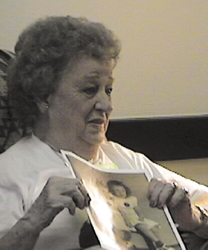 With
James stationed at Camp Bowie, Texas, Cora and her baby girl lived with Cora’s
father and struggled to survive on James’s $45 a month salary. “I guarantee
ya’ it was hard,” she says, “but I just had a lot of faith.” Along with her
faith Mrs. Hodges had her father’s help. “[Dad was] the only one I’d have
to help me,” she explains. “I didn’t have a mother [anymore].” The stress
of raising a child on her own still took a toll on Mrs. Hodges’s health, and
she lost nearly fifteen pounds during that long year. Everyone was relieved
when James returned to the Heights and his former job with the Houston Electric
Company in 1941.
With
James stationed at Camp Bowie, Texas, Cora and her baby girl lived with Cora’s
father and struggled to survive on James’s $45 a month salary. “I guarantee
ya’ it was hard,” she says, “but I just had a lot of faith.” Along with her
faith Mrs. Hodges had her father’s help. “[Dad was] the only one I’d have
to help me,” she explains. “I didn’t have a mother [anymore].” The stress
of raising a child on her own still took a toll on Mrs. Hodges’s health, and
she lost nearly fifteen pounds during that long year. Everyone was relieved
when James returned to the Heights and his former job with the Houston Electric
Company in 1941.