|
“I
was just eleven years old, and I didn't understand about the draft
and all. . . . I just thought that they were gonna' come one day . . . and get my daddy. Things like that worry a small person. |
|
 |
 |
|
A
Child's Story
|
|
|
-An
oral history of Valerie Jolly
|
Home | Table of Contents | Previous Story | Next Story
Personal Profile | Student Perspective | Video Interview
|
Like many children her age, Valerie helped collect scrap metal, paper, tinfoil, and other materials for various drives in the Heights. She also helped her mother collect grease and fats from cooking which could be used in the production of ammunition and to keep machines running smoothly. According to Mrs. Jolly, just one tablespoon of grease made five ammunition cases. “We had a saying,” she laughs, “Junk will win the war.” Valerie’s favorite volunteer activity was wrapping bandages at the local Red Cross. “I loved doing that,” she says. Mrs.
Jolly recalls that because the U.S. had to feed its troops overseas, special
emphasis was placed on food conservation at home. Food was rationed on the
home front, and families like Valerie’s were issued rationing stamps for a
variety of foods. Her family also kept a Victory Garden and a few chickens
to supplement their diet. Mrs. Roosevelt, the First Lady, had a weekly Mrs. Jolly reflects on the Heights community’s dedication to the war effort. “Everything went towards the war,” she says. “Everything we did was an effort for the war. . . . We did what was necessary, and we were proud to do it.” Nonetheless, the community was relieved and elated when the war came to an end. “Everybody went downtown to celebrate,” Valerie says with a smile. “People were in cars . . . hanging out the windows and just yelling. My daddy didn’t get home until twelve o’clock [that] night . . . but we got back in the car and all went downtown with him and celebrated some more.” |
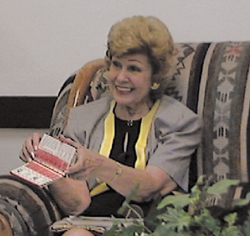 Valerie
Jolly, nee Ohler, was just a young child when Pearl Harbor was bombed, but
she vividly recalls the tense hours leading up to President Roosevelt’s declaration
of war against Japan. “Teachers all brought radios to school, and we listened
to Roosevelt’s speech,” she says. “It wasn’t long after that that people just
started doing what they could to make things better.” Valerie quickly overcame
her fear that her father would be drafted and began volunteering in support
of the war effort.
Valerie
Jolly, nee Ohler, was just a young child when Pearl Harbor was bombed, but
she vividly recalls the tense hours leading up to President Roosevelt’s declaration
of war against Japan. “Teachers all brought radios to school, and we listened
to Roosevelt’s speech,” she says. “It wasn’t long after that that people just
started doing what they could to make things better.” Valerie quickly overcame
her fear that her father would be drafted and began volunteering in support
of the war effort.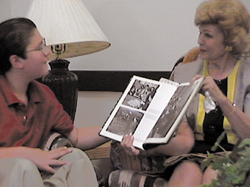 radio
show during which she gave tips on conserving food and other goods in the
household. Valerie remembers that Mrs. Roosevelt recommended mixing old coffee
grounds with fresh ones rather than using all fresh ones for each pot of coffee.
She also recalls Mrs. Roosevelt encouraging “Meatless Tuesday.” Every Tuesday
Valerie’s family would eat a main dish with beans or some other meat substitute
to make their meat ration last longer.
radio
show during which she gave tips on conserving food and other goods in the
household. Valerie remembers that Mrs. Roosevelt recommended mixing old coffee
grounds with fresh ones rather than using all fresh ones for each pot of coffee.
She also recalls Mrs. Roosevelt encouraging “Meatless Tuesday.” Every Tuesday
Valerie’s family would eat a main dish with beans or some other meat substitute
to make their meat ration last longer.