|
“We
took young men and made soldiers out of them.”
|
|
 |
 |
|
Making
Soldiers
|
|
|
-An
oral history of Louis Tisinger
|
Home | Table of Contents | Previous Story | Next Story
Personal Profile | Student Perspective | Video Interview
|
Although
Mr. Tisinger trained with the 36th for several weeks, he never faced the enemy
with them. Instead, he was sent to Fort Benning, Georgia for officer’s training.
After completing training, Lieutenant Tisinger was assigned to Camp Wolters
to train new soldiers. “I felt either cursed or blessed,” he reflects. “I
wanted to stay with my organization and go overseas, but they assigned everyone
a job. My job was to train troops.” At the same time, Mr. Tisinger realized
how fortunate he was to stay in the U.S. “Everyone had a role to play . .
. some in the Infantry, some in the Army, some in the Navy,” Louis explains.
“We took young men and made soldiers out of them.” “I recall very vividly . . . the training of other troops,” Mr. Tisinger says about his duties. He trained new recruits “physically, mentally, in weaponry, and tactics” for ninety days before they were sent overseas. Louis also recalls the emphasis placed on discipline, teamwork, and respect for authority. These qualities were needed in the new troops “so that when men were sent overseas to join a unit, they’d fit right in.” The duty of training replacement soldiers grew increasingly important as the war intensified. With units like the 36th losing thousands of men in battle, skilled and dedicated replacements were vital to the U.S. war effort.” Louis recalls several soldiers returning home safely to thank him. “I was gratified that some men came back and were grateful for the training.”
|
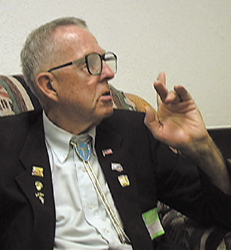 Mr.
Louis Tisinger decided to join the Texas National Guard in 1940, just as it
was mobilized and one year before Pearl Harbor was bombed. As a part of the
36th Infantry Division, he was based at Camp Bowie, Texas when the U. S. was
attacked. “I remember the Sunday morning that it happened,” he recalls. “It
was hard for me to believe. I was en route back to camp when I received the
news, and we wondered what was going to happen. . . . We were very much alarmed.
. . . Our training intensified, and we prepared to move overseas and meet
the enemy.”
Mr.
Louis Tisinger decided to join the Texas National Guard in 1940, just as it
was mobilized and one year before Pearl Harbor was bombed. As a part of the
36th Infantry Division, he was based at Camp Bowie, Texas when the U. S. was
attacked. “I remember the Sunday morning that it happened,” he recalls. “It
was hard for me to believe. I was en route back to camp when I received the
news, and we wondered what was going to happen. . . . We were very much alarmed.
. . . Our training intensified, and we prepared to move overseas and meet
the enemy.”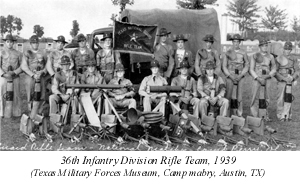
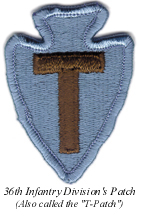 In
1943, after slightly more than three years of military duty, Mr. Tisinger
was discharged from service. He returned to his hometown, the Heights, and
began working in the oil industry. Today, Louis maintains the military’s ideal
of physical fitness by bicycling fifty to one hundred miles a week. This past
year he was the oldest participant in the two-day MS 150 bicycle trip from
Houston to Austin. Mr. Tisinger is proud to have served his country and pays
homage to those who serve in the military. “We have our freedom,” he quietly
declares, “which had been purchased and preserved by our military men, so
I’m always grateful to the military and feel that everyone should be grateful
when they recognize that.”
In
1943, after slightly more than three years of military duty, Mr. Tisinger
was discharged from service. He returned to his hometown, the Heights, and
began working in the oil industry. Today, Louis maintains the military’s ideal
of physical fitness by bicycling fifty to one hundred miles a week. This past
year he was the oldest participant in the two-day MS 150 bicycle trip from
Houston to Austin. Mr. Tisinger is proud to have served his country and pays
homage to those who serve in the military. “We have our freedom,” he quietly
declares, “which had been purchased and preserved by our military men, so
I’m always grateful to the military and feel that everyone should be grateful
when they recognize that.”Home | Table of Contents | Previous Story | Next Story