|
 When
Billy Miller was only sixteen years old, he made a decision that plunged him
deep into the flow of history. He joined the Texas National Guard and was
assigned to the 36th Infantry Division. The 36th crossed the Atlantic in early
April of 1943, headed for Algiers in North Africa to “assist the British
in the North African campaign.” The British regained control of the disputed
territory by the time the 36th arrived, so Billy and his division began amphibious
training and working with new weapons. On September 9, 1943, the 36th landed
at Salerno, Italy and made history. When
Billy Miller was only sixteen years old, he made a decision that plunged him
deep into the flow of history. He joined the Texas National Guard and was
assigned to the 36th Infantry Division. The 36th crossed the Atlantic in early
April of 1943, headed for Algiers in North Africa to “assist the British
in the North African campaign.” The British regained control of the disputed
territory by the time the 36th arrived, so Billy and his division began amphibious
training and working with new weapons. On September 9, 1943, the 36th landed
at Salerno, Italy and made history.
 The
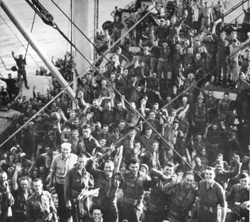
men of the 36th Infantry Division were “the first American troops of World
War II to land on European soil,” Mr. Miller modestly proclaims. He vividly
remembers the fear that gripped him when the enemy began firing during the
invasion. “What you are scared of,” Billy explains, “is things you don’t know.
. . . Yes, I was scared, but I didn’t know. We had never been familiar with
war.” The 36th battled across Italy and participated in the Rapido River action,
a maneuver intended to divert the Germans while Allied forces landed at Anzio
and prepared to take Rome. “The 36th Infantry Division had one of its biggest
casualty losses on the Rapido River,” Mr. Miller recalls. “It was swift and
cold and about eight feet deep . . . You couldn’t swim it.” The division’s
engineers made repeated attempts to build a bridge across the river, but never
succeeded. “We could put a [pontoon] bridge across that thing, but it wouldn’t
last. The [German] artillery . . . in three shots would have it knocked out.”
Nonetheless, the 36th landed at Anzio in May of 1944 and fought its way towards
Rome. After weeks of fighting, Mr. Miller took part in another historical
event when he participated in the capture of Rome. The
men of the 36th Infantry Division were “the first American troops of World
War II to land on European soil,” Mr. Miller modestly proclaims. He vividly
remembers the fear that gripped him when the enemy began firing during the
invasion. “What you are scared of,” Billy explains, “is things you don’t know.
. . . Yes, I was scared, but I didn’t know. We had never been familiar with
war.” The 36th battled across Italy and participated in the Rapido River action,
a maneuver intended to divert the Germans while Allied forces landed at Anzio
and prepared to take Rome. “The 36th Infantry Division had one of its biggest
casualty losses on the Rapido River,” Mr. Miller recalls. “It was swift and
cold and about eight feet deep . . . You couldn’t swim it.” The division’s
engineers made repeated attempts to build a bridge across the river, but never
succeeded. “We could put a [pontoon] bridge across that thing, but it wouldn’t
last. The [German] artillery . . . in three shots would have it knocked out.”
Nonetheless, the 36th landed at Anzio in May of 1944 and fought its way towards
Rome. After weeks of fighting, Mr. Miller took part in another historical
event when he participated in the capture of Rome.
 Following
the taking of Rome, the 36th moved to Naples where the division was resupplied
and retrained in preparation for the division’s impending landing in southern
France on August 15, 1944. There, the 36th continued fighting, making its
way along the Riviera and into the Rhone Valley. The unit moved around Switzerland
and into Austria where it accepted German Field Marshal Hermann Goering’s
surrender. By the end of the war, the 36th Infantry Division had suffered
the ninth highest casualty rate among all American Army divisions. Mr. Miller
and his comrades had made it through four hundred days of combat. He estimates
that 28,000 soldiers in his division were killed. “I was very, very fortunate,”
he solemnly says. “We were in some pretty bad situations.” Following
the taking of Rome, the 36th moved to Naples where the division was resupplied
and retrained in preparation for the division’s impending landing in southern
France on August 15, 1944. There, the 36th continued fighting, making its
way along the Riviera and into the Rhone Valley. The unit moved around Switzerland
and into Austria where it accepted German Field Marshal Hermann Goering’s
surrender. By the end of the war, the 36th Infantry Division had suffered
the ninth highest casualty rate among all American Army divisions. Mr. Miller
and his comrades had made it through four hundred days of combat. He estimates
that 28,000 soldiers in his division were killed. “I was very, very fortunate,”
he solemnly says. “We were in some pretty bad situations.”
When
the war ended, Mr. Miller was working in personnel, and although he “had more
service points than you could imagine,” he had to remain in Europe to process
the soldiers being discharged. He did, however, make it home for Thanksgiving
1945. Mr. Miller had little trouble adjusting to life back home, but he did
have trouble sharing his wartime experiences. “When I came home, I never talked
about it . . . and actually forgot ninety-nine percent of what happened,”
he explains. Mr. Miller eventually began meeting with the Houston chapter
of the 36th Infantry Division and sharing his stories, but he does not like
to boast about his service. “I wasn’t a war hero, but I made it.” Mr. Billy
Miller did more than just make it—he made history.
|