|
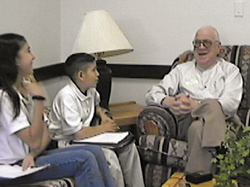 When
R. G. Musgrove was just nineteen years old, he surrendered his life as a student
at the Rice Institute (now Rice University) and joined the U.S. Army Air Force.
He was promptly sent to the California Institute of Technology where he studied
meteorology before being commissioned as a Second Lieutenant in the Eighth
Air Force. After spending six months in Marfa, Texas, Mr. Musgrove was transferred
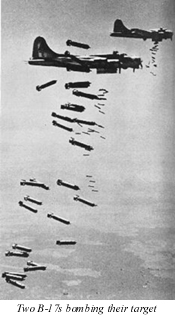
overseas to the 452nd Bomb Group base in Deopham Green, England. B-17 bombers
that flew strategic bombing missions in France and Germany called the 452nd
home, and it was Mr. Musgrove’s job to let the pilots know what weather conditions
to expect during flight. When
R. G. Musgrove was just nineteen years old, he surrendered his life as a student
at the Rice Institute (now Rice University) and joined the U.S. Army Air Force.
He was promptly sent to the California Institute of Technology where he studied
meteorology before being commissioned as a Second Lieutenant in the Eighth
Air Force. After spending six months in Marfa, Texas, Mr. Musgrove was transferred
overseas to the 452nd Bomb Group base in Deopham Green, England. B-17 bombers
that flew strategic bombing missions in France and Germany called the 452nd
home, and it was Mr. Musgrove’s job to let the pilots know what weather conditions
to expect during flight.
 As
second in command of the base’s weather station, Mr. Musgrove worked alongside
three other officers and six enlisted men to predict the weather. He says,
“[We] made the necessary observations of the weather—wind direction, speed,
how many clouds there were up above us, whether it was rainy or clear. . .
. These were sent to the central Air Force command, and maps were produced
. . . to be used to forecast the weather because we had to brief the bomber
pilots who went out . . . on missions.” As
second in command of the base’s weather station, Mr. Musgrove worked alongside
three other officers and six enlisted men to predict the weather. He says,
“[We] made the necessary observations of the weather—wind direction, speed,
how many clouds there were up above us, whether it was rainy or clear. . .
. These were sent to the central Air Force command, and maps were produced
. . . to be used to forecast the weather because we had to brief the bomber
pilots who went out . . . on missions.”
Despite
the strategic importance of Mr. Musgrove’s base to Allied operations, Axis
forces never directly attacked it. He reflects, “I was very fortunate during
the war because we were not directly in combat. . . . We were lucky our base
was never bombed by the Germans.”
 Nonetheless,
Mr. Musgrove was still in a war zone and had brushes with death and danger.
He recalls that later in the war the Germans developed a “terrible weapon”
called the V-bomb. “They were bombs that flew like an airplane. . . . It was
simply aimed at England and had a certain amount of fuel in it, and when the
fuel ran out, the [bomb] crashed,” Mr. Musgrove explains. Dozens sailed over
the base, but just one crashed nearby, in a field hospital, killing several
people. Nonetheless,
Mr. Musgrove was still in a war zone and had brushes with death and danger.
He recalls that later in the war the Germans developed a “terrible weapon”
called the V-bomb. “They were bombs that flew like an airplane. . . . It was
simply aimed at England and had a certain amount of fuel in it, and when the
fuel ran out, the [bomb] crashed,” Mr. Musgrove explains. Dozens sailed over
the base, but just one crashed nearby, in a field hospital, killing several
people.
Mr.
Musgrove returned to the U.S. unscathed in 1945. “When I got out of the war,
that was a happy day,” he remembers. “We were all happy to be home again and
to get back to America, to our families and friends, and to go back to work
. . . and start supporting our families.”
|