|
“I
decided that since this was the only time in history women had been allowed
in the Armed Services, it would just be a really remarkable thing to do --
to be a part of history.”
|
|
 |
 |
|
The
Story of a WAVE
|
|
|
-An
oral history of Evelyn Parker
|
Home | Table of Contents | Previous Story | Next Story
Personal Profile | Video Interview
|
Evelyn
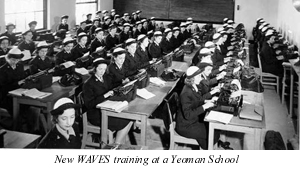
Donaldson left Houston with thirty-two other new recruits, and headed to New
York for Basic Training. After she completed Basic Training, she traveled
to Iowa for Yeoman School, where she learned secretarial skills and the basics
of military correspondence. Evelyn spent some time in Great Lakes, Illinois
before heading to the Navy airbase in Olathe, Kansas where she was stationed
for the remainder of the war. Traveling across the country was quite an experience
for Evelyn. She laughs, “It was pretty far for me because I hadn’t been out
of Texas yet. It was like being in a whole new world.” The young WAVE was
also surprised by the frigid weather in Kansas. “Being from Houston,” she
says with delight, “I had never been in snow. We’d have to wear boots and
gear like that.” Evelyn
describes her duties as a WAVE as basically secretarial, but also mentions
the variety of other jobs filled by her peers. Her fellow WAVES’s duties ranged
from training pilots in flight simulators to working on machinery. “We took
the jobs of men, so that they could go fight,” she explains. For their work,
WAVES were paid between thirty and fifty dollars month, but basic needs were
provided for. “You were given your food,” she says, “you were given your clothes.
You were given a place to stay so you really just needed spending money.”
Nonetheless, women in the service did sacrifice to contribute to the war effort.
“I couldn’t go home when I wanted. I couldn’t leave my job,” Evelyn says.
“Once you got in you had to stay until you were released.” Although Evelyn never traveled to the front, she still experienced some of the realities of war. She recounts the day a plane crashed at her base killing eleven Navy personnel. “It brought [home] to us what the war was because we thought, ‘This is only a little smidgen of what can happen during war.’” That incident was the closest Evelyn came to the dangers of war during her service. “When the war was over, they released the WAVES that were married first . . . because their husbands were coming home from overseas,” she says. Evelyn was discharged in October of 1945, shortly after the war’s conclusion. |
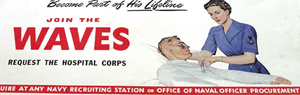 When
Evelyn Parker, nee Donaldson, graduated from Reagan High School, she was not
quite
sure what she wanted to do with her life. “Then the war started,” she recalls,
“and that made up my mind.” Evelyn remembers the influence that newsreels
had on her as well. “They showed you a synopsis of the war, . . . and it just
made you want to do something—either
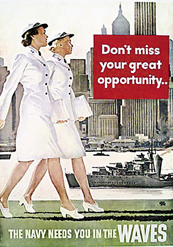
work in something in the U.S. to help in the war situation or to join.” In
February 1943, Evelyn did something; she joined a new division of the U.S.
Navy, the WAVES or Women Accepted for Volunteer Emergency Service.
When
Evelyn Parker, nee Donaldson, graduated from Reagan High School, she was not
quite
sure what she wanted to do with her life. “Then the war started,” she recalls,
“and that made up my mind.” Evelyn remembers the influence that newsreels
had on her as well. “They showed you a synopsis of the war, . . . and it just
made you want to do something—either
work in something in the U.S. to help in the war situation or to join.” In
February 1943, Evelyn did something; she joined a new division of the U.S.
Navy, the WAVES or Women Accepted for Volunteer Emergency Service.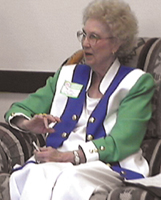
Home | Table of Contents | Previous Story | Next Story